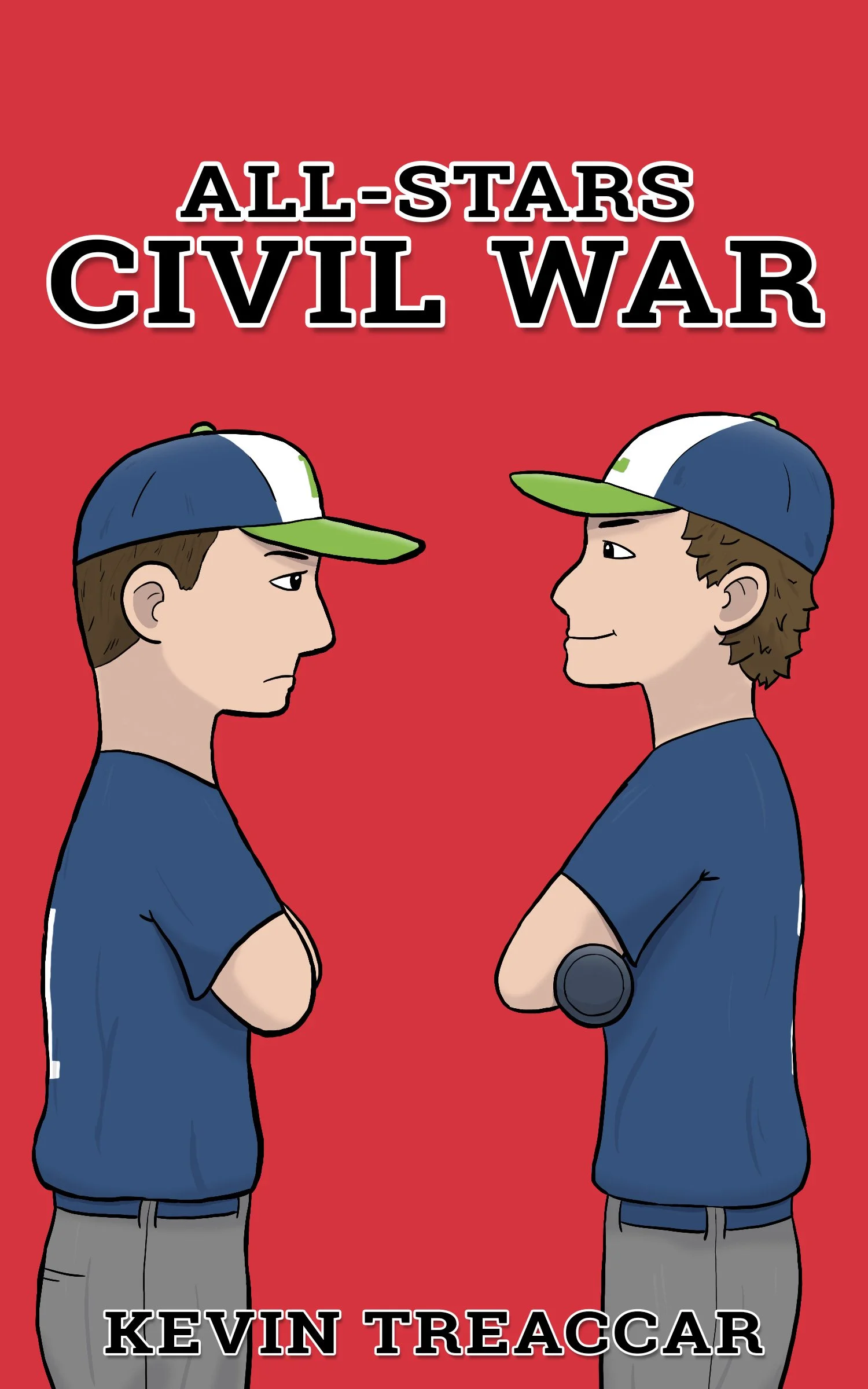
All-Stars Civil War
Rainer Thomas #2
A middle grade baseball novel
Available in paperback and on Kindle
THE STORY
“… revisits the baseball-obsessed 12-year-old as he’s forced to prove himself all over again.” —BookLife
The second book of this thrilling middle grade baseball series. Can Rainer survive playing All-Stars with his mortal enemy?
Interactions with Jake Winters nearly ruined baseball for twelve-year-old Rainer Thomas. Now they’re going to play together on the Lakeland All-Stars team.
Making matters worse, Jake’s dad is the head coach, meaning Jake’s dad will write the lineup and choose positions.
Sure, Rainer wonders if Lakeland has what it takes to make it to the Little League World Series. What he really wonders, though – will Rainer even see the field?
All-Stars Civil War is a middle grade baseball novel for young readers. This enemies-to-friends story will delight fans of Matt Christopher, The Sandlot and The Mighty Ducks.
Follow all of Rainer Thomas's adventure in a chapter book series great for reluctant readers who love baseball.
The Last-Place Legends (available now)
Showtime at Play Ball (coming soon)
REVIEWS
“… combines an action-packed sports narrative with a thoughtful star player…”
BookLife
After showcasing Rainer Thomas’s batting prowess and steady determination in The Last-Place Legends, Treaccar revisits the baseball-obsessed 12-year-old as he’s forced to prove himself all over again. No longer the new wunderkind in town, Rainer must step up his game after he’s chosen for the Little League All-Stars in Lakeland, Texas. Matters get complicated when Rainer’s nemesis, Jake Winters—whose father happens to be head coach—is chosen as starting shortstop, while Rainer’s assigned to play off the bench. That sets Rainer up for some heavy disappointment, an opportunity Treaccar takes to explore the camaraderie of teammates, navigating rivalries, and resolving past differences.
This lively middle-grade series focuses on both the discipline and joy of baseball, especially how individual achievements fit into the dynamics of team sports: Rainer’s ready for a summer of high-stakes regional match-ups, but creating a cohesive team with former foes isn’t easy. As the season progresses—and the Lakeland All-Stars dominate the competition—advancing to the Little League World Series becomes more important than misunderstandings and petty rivalries. For Rainer, the biggest struggle becomes developing the maturity needed to both prove himself and be a team player. “You’re going to get opportunities that most other baseball players dream about. You still have to earn them, though,” his father cautions early on.
Treaccar finds heart-warming moments in unexpected friendships, team building, and sportsmanship, as these ragtag competitors coalesce into a tight unit. He discusses the importance of practice—as well as strategy and fairness—and provides young readers with an in-depth look at Little League baseball, especially the nerve-wracking thrill of playing in All-Star tournaments. How the teammates deal with that pressure is a major part of their success. All-Stars Civil War combines an action-packed sports narrative with a thoughtful star player whose individual growth allows him to appreciate the benefits of baseball, whether it remains part of his life or not.
“… for anyone who has played youth baseball before.”
Readers’ Favorite

All-Stars Civil War by Kevin Treaccar follows twelve-year-old Rainer Thomas after he earns a spot on the Lakeland 12U All-Star team, something he has chased all season. What should feel exciting quickly gets complicated when Rainer ends up competing with Jake Winters, a strong shortstop, longtime rival, and the coach's son. As the team progresses through different stages and enters State play, Rainer faces challenges, with limited starts on defense, changing roles, and an ongoing need to prove himself against elite competition. He steps in where needed, throwing big pitches in key innings, gets timely hits, and takes over at shortstop during tense late-game moments. Meanwhile, Jake feels the weight of expectations shaped by his older brother's path in professional baseball. Intense games that end with close scores, along with both tough losses and hard-won victories, push both boys to face their doubts directly. By the end of the tournament run, teamwork, resilience, and earned trust matter more than status.
Kevin Treaccar's All-Stars Civil War is for anyone who has played youth baseball before. The narrative perfectly captures the demanding nature of All-Star tournaments. From managing pitch counts to navigating travel accommodations, sorting out lineup boards, and enduring long tournament days that test one's focus and patience, the details pull readers in without slowing the story. The plot unfolds seamlessly from selection to postseason play while maintaining high energy through intense games and emotional fluctuations. Rainer's character development is genuine; he shows leadership by working hard, making consistent decisions, and putting the team first, even when starting positions are not guaranteed. Jake's story, on the other hand, reveals how extreme pressure and frequent comparison may hurt even the most talented athletes. The writing is clear and engaging, particularly during game passages where the suspense rises with each inning. While some detailed play-by-play scenes might feel slightly too long, they effectively highlight how small details can determine game outcomes. The title All-Stars Civil War fits the story well, pointing to the internal conflict inside the team. I recommend this book to baseball players, students who play baseball, and sports writers, with its realism, strong character growth, and an honest look at team pressure.
BUY NOW
Available in paperback and on Kindle
READ CHAPTER 1
The batting cages were twelve-year-old Rainer Thomas’s happy place. Most of the time at least.
There was that trip a few months ago when he accidently got himself trapped into a bet that nearly ruined his life right after a big move. He had fought through that mess, though.
And now it was time to get ready for All-Stars.
That’s why Rainer was riding in the car with Dad to the batting cages. A tune-up.
Rainer could feel his anxiety pick up as they pulled into the parking lot. Three kids his age had made a few trips earlier in the spring quite stressful. Rainer did not feel like running into them today.
Maybe they would not be there, though. That’s what Rainer hoped.
As Dad parked, Rainer had his eyes locked on the cages and the mini golf area outside. No sign of them.
Rainer grabbed his bat, helmet and batting gloves before following Dad in. He kept his eyes up the entire time. No sign of the three rivals through the arcade and snack area either.
Rainer finally relaxed when they made it outside and he confirmed none of Jake, Tony or even Dexter were there to bother him.
Dad stepped away to get coins for the batting cages. Rainer slid on his helmet and gloves and picked his cage.
As usual, he grabbed a 50-miles per hour cage for warm up. He stretched and took practice cuts while he waited for Dad.
When Dad arrived, he handed Rainer a coin through the chain link fence. Rainer dropped it into the machine and then took his place in the right-hander batter’s box.
The yellow light turned on. After a moment, the red light turned on.
“Go” time.
As Rainer watched a ball drop into the chute, he came set in his stance. As the ball rolled down the chute, he slowly loaded his swing, stretching his hands back away from his body.
The machine fired the pitch. Rainer tracked it and fired his bat through the zone.
PING!
The ball shot off Rainer’s bat – a screaming line drive back at the cage.
Rainer repeated the swing four more times. Then he focused on hitting five line drives at the left field gap. He followed that with five line drives at the right field gap. He finished with five cuts swinging for the fences for fun.
“That looked good,” said Dad as the machine turned off.
“It felt good,” Rainer replied.
“Sixty?” asked Dad.
Rainer nodded as he worked his way out of the cage.
They quickly found an open 60-miles per hour cage. Dad handed over another coin and Rainer hopped in. He dropped the coin into the machine and took his place in the batter’s box.
Historically, kids Rainer’s age rarely touched sixty. He liked to prep for the higher velocities, though. Then everyone looked slower than what he was used to. That made for an easier adjustment rather than trying to speed up his swing.
Of course, Rainer would likely see higher velocities more often during All-Stars. These were supposed to be the best players from each local Little League. That was even more reason to train with sixty.
The machine lit up yellow, then red. Rainer prepared for the first pitch. Just like during his warmup, he focused on driving the ball back up the middle for the first five pitches. Then he focused on pulling five hard to the left. Then he drove five balls the other way to right field. Finally, he had fun swinging for the fences.
As the machine powered down, Rainer turned to collect another coin from Dad. As usual, a couple of other kids had stepped up to watch Rainer bat.
“Anyone?” Rainer asked, making sure no one else wanted a turn in the cage.
The kids waved him off.
“That was awesome,” said one kid. “Keep going.”
Rainer nodded as he took the coin from his dad.
“Can you give me situations?” Rainer asked.
“You got it,” Dad replied.
Through the next round, Dad told Rainer what type of hit he needed for imaginary situations. From line drives into gaps to deep fly balls for sacrifice flies to ground balls the opposite way that moved over runners, Rainer tried to produce whatever Dad asked for.
Rainer found success on about half his attempts through the first round. He found success on nearly all his swings during a second round of the game.
A crowd had developed around Rainer’s cage by the time he finished that second round. Some of the kids were even almost regulars who had seen Rainer in the cages on multiple occasions the last few months and tended to drift over to watch when they were at the entertainment complex at the same time.
“Keep going!” yelled one of the kids.
Rainer chuckled and walked back over to his dad for another coin.
“Last one,” said Dad. “How about you go try a seventy cage?”
“Can’t you get more coins?” Rainer asked.
“Not today,” said Dad. “Let’s go try seventy since you might run into that in All-Stars.”
“We can’t get more?” said Rainer looking around at all the kids watching him hit. “They’re all enjoying this.”
“No more,” said Dad with a ‘Not right now’ expression. “Sixty or seventy?”
Rainer knew to let it go. He was walking himself into trouble trying to get more coins.
“Seventy,” he said.
BUY NOW
Available in Paperback and on Kindle